Process
How does data recovery work?
Send your drive
In person or by courier to our facility.
Diagnosis and report
We assess the device condition, damage type and recovery options, then prepare a quote. Diagnostics takes from 5 business days (standard) or up to 48 h (express).
Recovery
You decide whether to proceed based on the technical report and file list.
Collection
We copy the recovered data to a new drive or make it available for secure download from our server (up to 10 TB).
Approximate costs
How much does HDD data recovery cost?
Analysis
Standard: €65
Express 24/7: €250
- Detailed technical report
- Recovery cost quote
- List of recoverable files
Logical damage
€130–€310
Typical range for drives up to 4 TB
- Deleted files or folders
- Partition read error
- Drive requires formatting
Physical damage & firmware
€220–€830
Typical range for drives up to 4 TB
- Slow copying
- System freezing
- Read errors / no data access
- Clicking or squealing
- Drive after a fall
Unusual or particularly complex cases are quoted individually after analysis.
Video from the lab
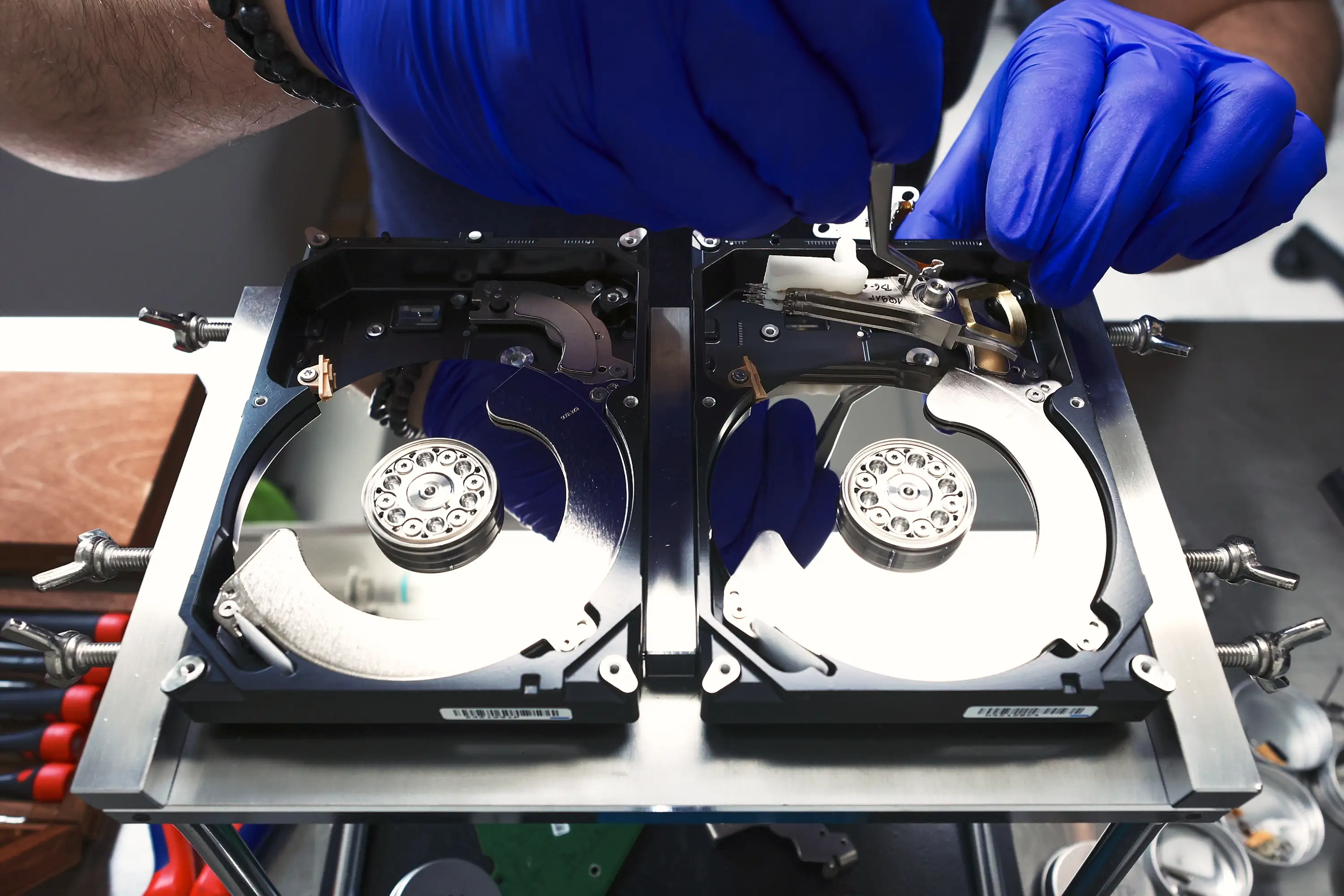
Seagate head replacement
See how the process works in practice
We film our work to show the real service process. The video below is a complete head replacement procedure on a Seagate SMR M11 drive — one of eight heads failed, requiring replacement of the entire head assembly and supplementary reading, resulting in over 99% of files recovered.
Technical equipment
Tools
for specialist work
We are not limited to off-the-shelf solutions. We develop our own procedures and proprietary reading methods that allow us to recover data where standard tools fail.
Hardware-software interfaces
- AceLab PC-3000 Express with RAID extension
- AceLab PC-3000 Express with SSD extension
- AceLab PC-3000 UDMA with SSD extension
Specialist tools
- KM Clean Air Lamil 10 laminar flow chamber
- HddSurgery tools
- ApexToolLab tools
Laboratory equipment
- JBC and Quick soldering equipment
- Fluke measurement instruments
- QIANLI SUPERCAM X 3D thermal camera
FAQ
Frequently asked questions
Is the analysis included in the recovery price, and what does it cover?
No. Analysis is a separate service paid upfront (€65 standard or €250 express), which keeps the recovery itself cheaper than at labs offering "free diagnostics". It covers a thorough examination of the drive, identification of the failure type, and an assessment of recovery chances. Based on the results we classify the case, prepare a report, and provide an exact quote.
How long does HDD data recovery take?
The turnaround depends on the drive model and extent of damage. Simpler cases typically take 5–7 business days; more complex ones take longer accordingly. We give an exact timeline after the diagnostic is complete.
Do you recover data from every drive model?
Yes. We recover data from HDD and SSHD drives in 2.5" and 3.5" form factors, SATA, PATA (IDE), external and server models from most manufacturers — Seagate, Western Digital, Toshiba, HGST, Samsung. For very rare models we will inform you of any limitations after the diagnostic.
Is the recovered data safe and confidential?
Yes. All work is performed in a controlled laboratory environment. Data is processed only on dedicated workstations, and we can sign an NDA upon request.
Can I continue using a drive that shows signs of failure?
No. Every write operation or power-on attempt reduces the chances of successful data recovery. Power off the drive and do not reconnect it until you speak with a specialist.
Is it worth scanning or repairing a damaged drive with software?
No. Hours-long scans and repair attempts put additional strain on the damaged drive and accelerate its degradation. Every failed attempt reduces the chances of a successful recovery later.
Can I open the hard drive casing myself?
No. Dust and contaminants in home conditions immediately destroy the platter surfaces. Opening a drive outside a cleanroom almost always results in additional damage or permanent data loss.
Get in touch
Describe your HDD problem
You don't need to know the technical details. A brief description of what happened is enough — our engineer will assess the situation and outline the possible approaches.